
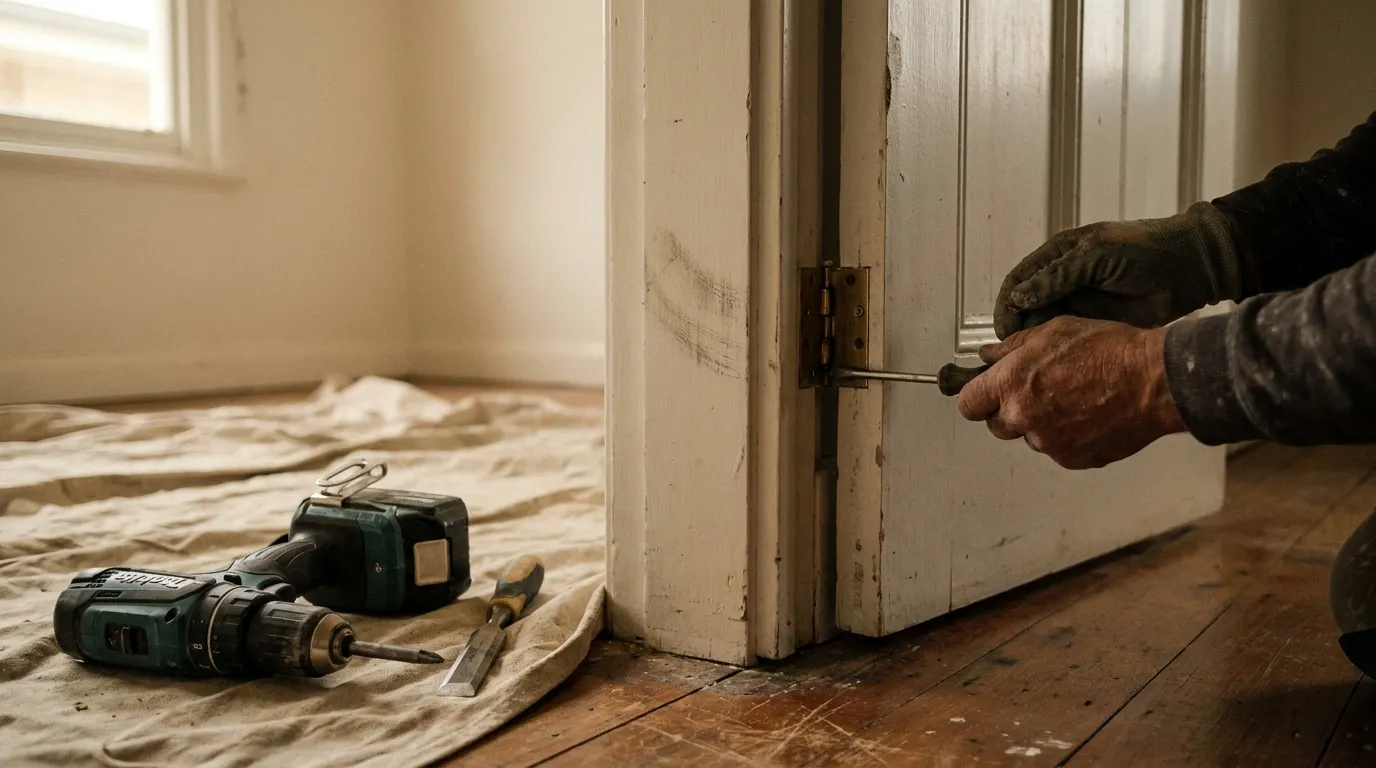
People ring us about a door once it has stopped working entirely, and the first thing most of them say is some version of "I think it needs replacing". Occasionally that is true. Most of the time the door is fine and something around it has moved, worn out or swollen, and the fix is an hour with the right tools rather than a new door, a new frame, painting and making good.
This is the diagnosis we run through on a call-out, written down so you can do the first half of it yourself before you ring anyone.
Start here: it is usually not the door
A door is a rectangle hung off three hinges into a frame, with a latch that has to line up with a hole. Almost every fault is one of four things:
- The hinges. Screws have pulled in the frame, so the door has dropped and now rubs on the far side or the floor.
- The latch or striker. The tongue no longer meets the plate, so the door pushes shut and swings back open.
- The rollers or track on a sliding or screen door, worn flat or packed with grit.
- The timber itself, swollen with moisture and binding in the frame.
Only the last of those is the door, and even then it is normally an easing job rather than a replacement. Work out which one you have and you already know roughly what you are up for.
THE TWO-MINUTE TEST
Open the door about halfway and let go. If it swings closed or open on its own, the frame or the hanging is out of plumb. Now close it slowly and watch where it touches first: the top far corner means the door has dropped on its hinges, the bottom far corner means it has lifted, and even contact all the way down usually means swelling. Finally look at the striker plate for a shiny witness mark above or below the hole, which tells you exactly how far out the latch is sitting.
Hinges, latches and strikers: the cheap fixes
This is the largest single category of door work we do, and the one people most often live with for months. A door that has dropped is usually loose hinge screws in a soft frame, and the common mistake is to drive the same screws back into the same tired holes and hope. They hold for a week. The repair is to pack or plug the holes properly so there is fresh timber for the screw to bite, then reset the hinge and re-hang the door square.
A latch that will not catch is normally a striker plate that needs moving a few millimetres, or a plate whose opening needs filing. Either takes minutes. A handle that spins, a spindle that has worn or a lock body that has failed is a swap, and we carry common hardware.
Things worth knowing before you start pulling a door apart yourself:
- Take the weight of the door before you touch the hinge screws, otherwise the remaining hinges take the load and pull too.
- Longer screws into the frame stud fix more dropped doors than any other single trick.
- Do not plane a door because it is catching at one corner. Fix the hanging first. Once timber is off, it does not go back on.
- If the door is a fire door, in an apartment corridor for example, it is not a general handyman job and the certification matters.
Sliding doors: rollers and tracks, not glass
A stiff sliding door is mechanical nine times out of ten. The rollers underneath wear flat or seize, and the bottom track fills with grit and corrodes, so the door drags along the track instead of rolling on it. We lift the door out, replace the rollers, clean or repair the track, then re-hang and adjust the height so it runs with one finger.
Two Canberra-specific notes. Sliding and screen doors here collect a lot of dry grit and shed bark through summer, particularly in the treed inner south suburbs like Red Hill where the streets sit under the nature park, and that grit is what destroys rollers. And in apartment buildings, balcony sliders often sit on the boundary between your lot and common property, so in a suburb like Kingston the first question is who owns the door, not what is wrong with it.
What a sliding door repair is not: glass. Cracked or shattered glass is a glazier's job and we will point you to one. If the glass is fine and the door will not move, that is squarely our door and sliding door repair work.
Keeping a sliding door running: the 10-minute routine
Grit is what kills rollers, so the whole routine is about getting it out of the track before the wheels run over it. In Canberra the useful moment is the end of summer, once the dry grit and shed bark have had their season, and again before winter. It needs a vacuum, a stiff brush and a cloth.
- Vacuum the bottom track with the crevice tool, then scrub out what is left in the corners with a stiff brush or an old toothbrush. Packed grit in the corners is what files the wheels flat.
- Wipe the track down with warm soapy water and dry it properly.
- Leave the oil and grease in the shed. Anything wet on the track holds grit and turns it into grinding paste. If the door still needs help, a light dry silicone spray on the track is the most it should get.
- Clear the drainage slots along the outside edge of the track so rainwater drains away instead of sitting in the channel.
- Slide the door end to end and listen. A clean track and a door that runs quietly means you are done.
If the door still grinds on a clean track, sags lower at one end, or jumps off at the same spot every time, the rollers are worn and no amount of cleaning brings them back. That is a roller swap, which is standard sliding door repair work.
Swollen timber and the Canberra seasons
Canberra gives timber doors a harder life than the coast does. Cold, damp winters and hot, dry summers mean the same door swells and shrinks noticeably through the year, and a door that closed cleanly in March can bind by July. The classic version is an external timber door or a bathroom door that has taken up moisture, gone slightly oversize and now needs a shoulder.
The judgement call is whether to ease it or wait. If a door binds only in the wettest part of winter and runs freely by November, taking timber off in July leaves you with a gap and a draught for the rest of the year. If it binds year round, easing the edge and resealing it is the right fix. We would rather tell you to leave it than take material off a door that will be fine in six weeks.
Two things that make swelling worse and are worth fixing at the same time: a bare, unsealed door edge or bottom that is drinking moisture straight in, and a missing weather seal that lets driving rain sit against the base of an external door. Both are quick and both are cheaper than the damage they cause.
When it is the frame, not the door
Sometimes the door really is a symptom. The signs that the problem is structural rather than hardware:
- The gap around the door is visibly wider at one end than the other, tapering top to bottom.
- There is fresh cracking in the plaster running diagonally from the top corner of the door or window frame.
- More than one door in the same part of the house has started sticking in the same season.
- The floor near the doorway has developed a slope or a spring in it.
That is the house moving, usually ground movement under the footings, and adjusting the door only buys time. We will still make the door work, but we will tell you plainly that we are treating the symptom and that a builder or a structural engineer should look at the cause. Rot at the bottom of an external frame is the other case: if the jamb is soft when you press a screwdriver into it, the frame section needs repairing before the door is worth touching, which is carpentry work rather than an adjustment.
What we do not touch, and who to call instead
Being straight about this saves everyone a wasted visit:
- Garage doors and garage door motors. Springs and drive units need a garage door specialist with the right parts. We do not take them on.
- Glass. Cracked, shattered or fogged double glazing is a glazier.
- Restricted and master-key locking systems. Standard locks, deadbolts and handles we fit. Restricted keyways and master-key suites are a licensed locksmith.
- Fire-rated doors in apartment and commercial buildings, where any work has to preserve the rating.
- Automatic and commercial entry doors. Different trade entirely.
If your job is one of those, we will say so on the phone and point you the right way. There is more on where handyman work starts and stops in handyman vs licensed tradie in Canberra, which sets out the jobs that need a licence.
What to send us so the quote is right first time
Door jobs are quoted well from photos, and badly from descriptions. What actually helps:
- One photo of the whole door, open, from a few steps back, so we can see the type and how it is hung.
- A close photo of the hinge side, and one of the latch and striker plate.
- For a slider, a photo of the bottom track along its length and one of the door's bottom edge.
- A line on when it started and whether it comes and goes with the weather.
- Anything else on the list while we are there. Doors are rarely the only thing.
Send those with your address and our team comes back with a fixed price. Grouping a few small jobs into one visit is always cheaper than calling us out for each one as it fails.
A quick FAQ
Can a handyman fix a door that will not close?
Yes, and it is one of the most common jobs we get. A door that will not close is usually a dropped hinge, a misaligned striker plate or swollen timber, and all three are standard handyman repairs. It only stops being our work if the frame itself has failed or the door is fire rated.
Is it cheaper to repair a door or replace it?
Repair, in most cases, and by a wide margin. Replacing a door is not just the door: it is the hanging, the hardware, the making good and the painting. Most of what people assume is a replacement turns out to be hardware or an adjustment. We tell you when a door genuinely is past it rather than sell you a repair that will not hold.
Why do my doors stick in winter in Canberra?
Cold, damp winters and hot, dry summers move timber. Doors take up moisture in the colder months, go slightly oversize and bind in the frame, then shrink back once the weather turns. If it only happens in the wettest part of the year, easing the door can leave you with a gap in summer, so the better fix is often to seal the exposed edges and adjust the hanging instead.
Should I oil sliding door rollers?
No. Oil and grease hold on to grit, and grit is what wears rollers out. Keep the track clean and dry, and use a light dry silicone spray at most. If a squirt of lubricant is the only thing keeping the door quiet, the rollers are already worn and need replacing.
How often should I clean a sliding door track?
At the end of summer and again before winter suits most Canberra homes. Do it more often if the door opens onto a treed yard, a dusty balcony or a garden bed. If you can see grit sitting in the track, it is due.
Which suburbs do you cover for door repairs?
Canberra, Queanbeyan and the surrounding area, including the Woden Valley, the Inner South, Belconnen, Gungahlin and Tuggeranong districts. Ring and confirm your address if you are not sure.
Got a door that has been annoying you for months? Send photos of the door, the hinge side and the latch to 0424 705 056 with your address and we will quote a fixed price. We cover Canberra, Queanbeyan and the surrounding area.